HEC Degree Attestation: A Complete Step-by-Step Process for 2025
abdul_waheed

Navigating HEC Degree Attestation: Your Step-by-Step Guide to a Stress-Free Process
The Purpose of HEC Attestation: More Than Just a Stamp
Before you embark on the HEC attestation process, it’s crucial to understand its purpose. HEC attestation is the official verification that your educational documents - your degrees and transcripts - are authentic. This process confirms three critical things to any foreign institution or employer:
- Your degree is genuine. It wasn’t forged or obtained from a fraudulent source.
- Your university is legitimate. The institution you attended is a recognized, chartered university with the authority to grant degrees.
- Your program was HEC-approved. The specific course of study you completed meets the quality standards set by Pakistan’s highest educational authority.
Think of it as an academic passport. Without it, your Pakistani qualifications have limited value in the international arena. Whether you’re applying for a Master’s program in Canada, seeking professional licensing in the Middle East, or getting your credentials assessed by World Education Services (WES), an HEC-attested degree is the foundational requirement.
Your Pre-Flight Check: Gathering Your Documents
Don’t jump into the online portal without proper preparation. A successful attestation journey begins with meticulous organization. Gather and scrutinize every required document before creating an online account.
The Core Documents: Your Academic Trail
This is the heart of your application. You will need the original documents for every qualification you want to be attested, as well as all preceding qualifications. HEC works on a chain-of-command principle; you cannot attest a Master’s degree without first having your Bachelor’s, Intermediate, and Matric certificates in order.
Your checklist must include:
- Matriculation (SSC) Certificate: The original certificate issued by your board.
- Intermediate (HSSC) Certificate: The original certificate issued by your board.
- Bachelor’s Degree and Transcript: The original degree and the final, consolidated marks sheet (transcript).
- Master’s Degree and Transcript: (If applicable) The original degree and transcript.
- PhD/MPhil Degree and Transcript: (If applicable) The original degree and transcript.
Crucial Note: Ensure all degrees and transcripts are the final, official versions issued by the university’s Controller of Examinations, not provisional certificates.
Identification and Personal Records
Alongside your academic papers, you will need clear copies of your personal identification:
- Computerized National Identity Card (CNIC): A clear, valid copy of both the front and back.
- Passport: If you are a foreign national or have dual nationality.
- Passport-sized Photographs: Have a few recent, professional photos with a white or blue background on hand. You will need to upload a digital version.
A Critical Note on Program Recognition
This is a step that can save you from immense frustration. Before you proceed, verify that your university, the specific campus you attended, and the exact degree program you completed are all recognized by the HEC. Sometimes, a university might be recognized, but a specific program or a sub-campus might not be.
You can do this by visiting the official HEC website and using their “Recognized Universities and Programs” search tool. Discovering an issue at this stage is far better than after you’ve paid the fee and submitted your application.
Step 1: Conquering the Online Portal
The entire attestation process is managed through the HEC’s E-Services portal. Your first practical step is to create a comprehensive and accurate profile.
Go to eservices.hec.gov.pk and register for a new account. The system will guide you through a multi-step profile creation process. This is where your meticulous document gathering pays off.
Profile Creation: Accuracy is Key
Your online profile is the digital twin of your physical application. Any discrepancy here can lead to delays or rejection. Pay close attention to the following sections:
- Personal Details: Enter your name, father’s name, and date of birth exactly as they appear on your CNIC and academic documents. A slight variation like “Muhammad” vs. “Mohammad” can cause problems.
- Educational Records: This is the most time-consuming part. You must enter details for every qualification, starting from Matric and going up to your highest degree. You will be asked for your roll number, registration number, years of study, and marks obtained. Double-check everything against your original documents.
- Uploading Documents: You will be required to upload scanned copies of your CNIC, degrees, and transcripts. Ensure your scans are clear, legible, and in the specified format (usually PDF or JPG). A blurry or cropped scan will get your application flagged.
Take your time with this step. Fill it out, save your progress, and come back to review it with fresh eyes before final submission.
Step 2: Submitting Your Attestation Application
Option A: The Walk-in Process (Urgent Attestation)
This is the fastest method, designed for those who are short on time or prefer to handle the process in person.
- How it Works: After submitting your application online, you will be able to schedule an appointment at an HEC office in Islamabad, Karachi, Lahore, Peshawar, or Quetta. You pay the urgent processing fee online and receive a confirmation of your scheduled date and time. On the day of your appointment, you visit the HEC office with all your original documents, a copy of the application form, and the fee receipt. If everything is in order, you typically receive your attested documents back the same day.
- Tips for a Smooth Visit:
- Arrive Early: Get there at least 30 minutes before your scheduled time.
- Organize Your Documents: Keep your originals, photocopies, and application form in a neat file, in chronological order.
- Be Patient: The offices can be crowded. A calm and polite demeanor goes a long way.
- Follow Instructions: Listen carefully to the officials at each counter. They are processing hundreds of applications and will guide you through their internal system.
Option B: Attestation Through Courier
This is the more convenient option for those who do not live near an HEC office or are not in a major rush.
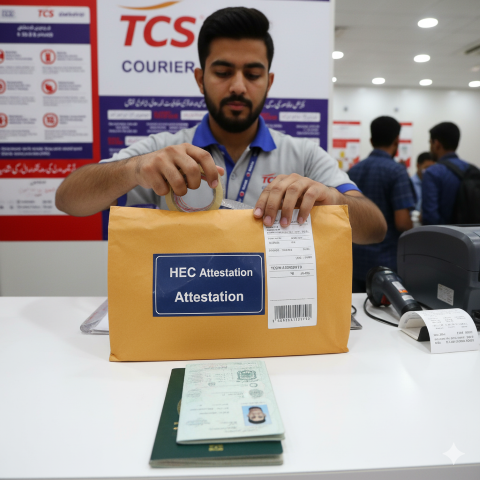
- How it Works: You select the courier option during your online application. After submission, you will print the application form and the system-generated bank challan for the normal processing fee. You pay the fee at the designated bank and then package your original documents, the signed application form, and the original fee receipt. This package is then sent via the HEC’s designated courier service (usually TCS in Pakistan) to the HEC headquarters in Islamabad. The HEC processes your documents and sends them back to your registered address via the same courier service.
- Tips for a Secure Process:
- Trust the System: It can be nerve-wracking to send your life’s most important documents via courier. However, this is a well-established and secure system used by thousands of applicants.
- Secure Packaging: Use a sturdy, waterproof envelope.
- Keep Your Tracking Number: The courier will provide a tracking number. Keep it safe and monitor your package’s journey to and from the HEC.
- Account for Time: The courier process typically takes 10-15 working days, but this can vary. Plan accordingly.
Step 3: Paying the Piper: The Attestation Fees
The cost of attestation is straightforward and is clearly outlined on the HEC website. It’s essential to know the breakdown to calculate your total cost accurately.
- Original Documents: There is a fee for each original document (e.g., a degree or a transcript). As of the latest updates, this is around PKR 1,000 per original.
- Photocopies: If you also need photocopies of your documents attested (which is often required for WES and other services), there is a separate, lower fee for each copy. This is typically around PKR 700 per page.
- Urgent vs. Normal: The urgent (walk-in) fee is significantly higher than the normal (courier) fee. You are paying a premium for speed and convenience.
Payment can be made through online banking, ATM transfers, or by depositing a bank challan at designated bank branches like HBL or NBP. Always keep the original proof of payment.
Navigating the Maze: Common Roadblocks and Expert Solutions
Even with careful preparation, you might encounter some common issues. Knowing what they are and how to solve them can prevent panic.
The “Incomplete Prerequisite” Error
This happens when you try to apply for the attestation of a higher degree (e.g., a Master’s) without having first entered the details of your preceding qualifications (Bachelor’s, HSSC, SSC) in your profile. The solution is simple: go back to your profile and meticulously add the details for all lower-level qualifications first.
Discrepancies in Personal Details
A common problem is minor variations in your name or father’s name across your documents (e.g., “Syed Ali Raza” on your CNIC but “Syed A. Raza” on your degree). If the HEC flags this, you may need to provide a legal affidavit, prepared on stamp paper and verified by an oath commissioner, clarifying that all name variations belong to the same person.
The Dreaded “Further Verification Required” Status
Sometimes, your application status might change to “In Verification.” This isn’t a rejection. It means the HEC has sent a query to your university to re-confirm the authenticity of your degree. This usually happens with older degrees or if there’s a slight discrepancy in their records. The best course of action is patience. You can also politely follow up with your university’s Controller of Examinations office to ensure they respond to the HEC’s query promptly.
The Finish Line: Your Attested Documents are Ready
Whether you collect them in person or receive a package from the courier, the moment you hold your attested documents is a huge relief. The distinctive HEC stamp and the signature of the attesting officer are now on your papers.
Before you file them away, do two things immediately:
- Scan Everything: Make high-quality color scans of the front and back of every attested document. Save these securely in the cloud.
- Store Safely: Keep the original documents in a safe, waterproof folder. These are now even more valuable.
With your degrees now officially attested by the HEC, you have successfully completed a critical step. The path is now clear for your subsequent applications, whether it’s for university admissions, professional assessments like WES, or visa processes that require MOFA (Ministry of Foreign Affairs) attestation—a process that is only possible after the HEC has done its part.
The HEC attestation process, while detailed, is not the insurmountable obstacle it’s often made out to be. With preparation, attention to detail, and a clear understanding of the steps involved, it is a perfectly manageable task. You have conquered your academic challenges to earn these degrees; you can certainly conquer the paperwork required to validate them. Your global future awaits, and this is the first, crucial stamp in your new passport to success.
Your Passport to Global Ambition
Navigating the HEC attestation process can seem daunting, but it is a critical step towards unlocking your global ambitions. With the right guidance and preparation, you can successfully navigate this process and take the first step towards achieving your goals.
As the renowned poet Rumi once said, “The wound is the place where the light enters you.” Your educational journey has given you the light of knowledge, and now it’s time to let that light shine globally.